Transforming Your Space Cooler
Thermal Performance
How MCM Coverings Helps Keep Your Space Cooler
A plain-language guide to indoor thermal comfort and why cladding material choice matters in Singapore's tropical climate
0.059
W/(m·K)Thermal Conductivity
50%
Cooling Load Reduction in Optimised Systems
4°C
Outdoor Surface Temp Reduction Near Facade
WHY THIS MATTERS NOW
Singapore is getting hotter. Officially.
Singapore's National Environment Agency confirmed that 2024 was the hottest year on record. Government projections warn Singapore has already broken heat records three times in the last decade. It is not getting cooler. More heat means more airconditioning, higher energy bills, and less comfortable spaces.
MCM Coverings is one of the most practical decisions you can make today to slow that heat down before it gets inside.
+0.24°C
per decade rise in Singapore temperature since 1984
Source: National Environment Agency Annual Climate Assessment 2024 and Singapore Third National Climate Change Study (V3), January 2024

UNDERSTANDING THE PROBLEM
Why Buildings Get Hot Indoors
In Singapore's tropical climate, outdoor temperatures regularly reach 32 to 35°C. That heat does not stay outside. It travels through walls, ceilings, partitions, and cladding surfaces, slowly making its way indoors and raising the temperature of your space. As the diagram shows, a bare concrete wall allows solar heat to pass straight through into your interior. A metal substrate such as aluminium transfers heat almost instantly. But when MCM Coverings is applied, its low thermal conductivity of 0.0590 W/(m·K) reflects a significant portion of heat at the surface and resists the rest from conducting inward. The result is a measurably cooler indoor space, not through one mechanism alone, but through the combined effect of reflection, resistance, and replacing a highly conductive surface with an insulation-grade one.
Left: Bare concrete wall lets solar heat pass through freely. Centre: Metal substrate transfers heat almost instantly. Right: Wall with MCM Coverings (A = 0.0590 W/(m·K) reflects and resists heat, producing a cooler indoor space.
HOW IT WORKS
How MCM Coverings Acts as an Indoor Thermal Break
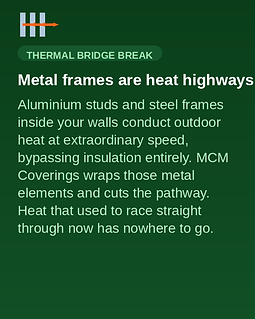
Most cladding just sits on a wall. MCM Coverings does three things at once, it upgrades the surface temperature of your substrate, cuts off heat pathways through metal frames and studs, and adds its insulation value to the total wall system. The result is a wall that works significantly harder at keeping heat where it belongs, outside.



MATERIAL COMPARISON
MCM Coverings vs Common Building Materials
The lower the thermal conductivity value, the harder it is for heat to pass through. MCM Coverings outperforms most surfaces it is applied to.
.png)
WHERE IT WORKS
Versatile Across Every Indoor Surface
MCM Coverings is compatible with virtually all building and interior substrates, including concrete walls, gypsum partitions, plywood, MDF, timber carpentry, aluminium frames, and steel honeycomb systems. Across allapplications it acts as an insulation-grade outer surface, reducing solar heat absorption and moderating heat transfer into the substrate. The greatest thermal benefit occurs in metal-faced assemblies, where MCM Coverings provides the primary resistance of the entire system.
.png)